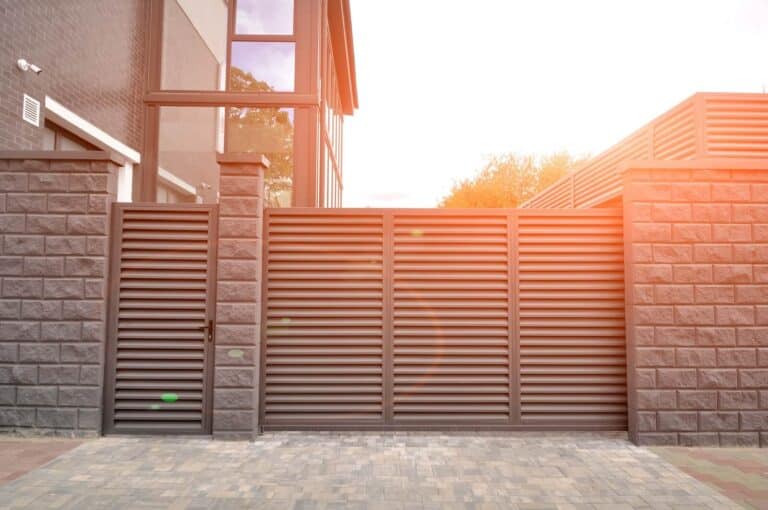
Working out the electric gate cost for a property in Australia is the first question almost everyone asks, and the honest answer is that prices vary widely. Gate type, size, materials, automation level, and site conditions all push the number up or down. A simple swing gate on a flat suburban driveway looks nothing like a heavy double sliding gate on a sloped block. At Long Life Gates, we have been designing, building, and installing electric gates since 1977, so the ranges below reflect what Melbourne property owners are paying in 2026.
As a quick guide, expect to pay $4,000 to $10,000 for a standard residential electric gate fully installed in Australia in 2026. Premium or commercial setups push past $15,000. Adding automation to an existing manual gate typically runs $1,500 to $4,000.
Key takeaways
- Most Australian homeowners pay $4,000 to $10,000 fully installed in 2026.
- Single swing gates sit at the lower end. Double swing and sliding gates cost more.
- Motor hardware alone is $700 to $3,000 supply only, or $1,500 to $4,000 installed.
- Site factors (slope, electrical, civils, intercoms, permits) often add $1,000 to $3,000 buyers do not budget for.
- Annual maintenance runs $200 to $400.
- Always get a written quote that itemises gate, automation, civils, and access control separately.
What goes into the cost of an electric gate?
An electric gate quote stacks several costs together, and a change to any one can move the total by thousands. The main drivers:
- Gate type: swing, sliding, cantilever, or bi-fold.
- Single vs double configuration. Double gates roughly double the fabrication and often need two motors.
- Size, weight, and material. Heavier gates need stronger motors. Steel, aluminium, Colorbond, timber, and wrought iron sit at different price points.
- Automation level. Basic remote vs intercom, smartphone, and sensors.
- Power source. Mains 240V, low voltage DC, or solar.
- Site conditions. Slope, distance to power, civils, and access all affect labour.
- Access control add-ons. Intercoms, keypads, photocell sensors, apps.
- Council permits and Australian Standards compliance.
- Labour rates. Capital city installs sit higher than regional Australia.
A basic kit on a forgiving site is one number. A premium fit-out with civils on a sloped block is another. A quote based on photos and measurements is faster than modelling your own, which is why reputable installers offer free quotes and professional gate installation as a combined service.
Average electric gate cost in Australia (2026)
In Australia in 2026, expect to pay $4,000 to $10,000 fully installed for a residential single or double electric gate. Sliding gates start around $4,000 and reach $12,000 heavy-duty. Single swing gates run $3,000 to $7,000 installed. The table summarises typical installed pricing across eight published Australian gate suppliers as at April 2026.
| Component | Typical price (AUD, installed) | Premium / high end |
|---|---|---|
| Single swing gate (installed) | $3,000 – $7,000 | up to $9,900 |
| Double swing gate (installed) | $5,000 – $10,000 | up to $14,500 |
| Sliding gate, residential (installed) | $4,000 – $8,000 | $12,000 – $15,000 |
| Bi-fold gate (installed) | $5,000 – $7,000 | up to $18,000 |
| Adding automation to an existing gate | $1,500 – $4,000 | up to $6,500 |
| Solar power kit add-on | $2,000 – $3,500 | up to $5,000 |
Source: synthesised from publicly published 2024 to 2026 pricing across eight Australian gate suppliers. Current as at April 2026, excludes GST unless stated. Site-specific quote required for an accurate figure.
These are the headline figures most property owners compare against when researching driveway gates. Treat them as a sanity check on quotes you receive, not a target price.
Cost by gate type: swing, sliding, cantilever, and bi-fold
Swing gate cost (single and double)
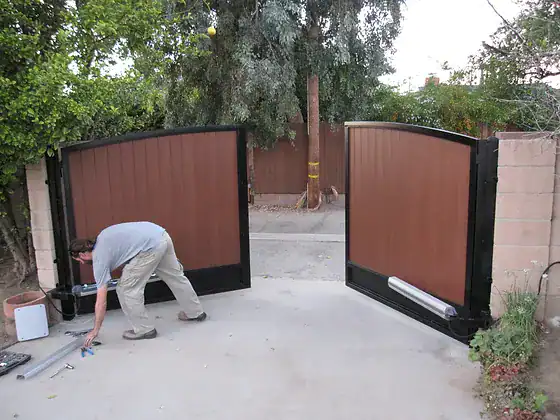
A single swing gate runs $3,000 to $7,000 installed for a basic to mid-range setup, with premium fit-outs reaching $9,900. Double swing gates sit at $5,000 to $10,000, with premiums reaching $14,500. The gap exists because a double swing gate needs two leaves of fabrication and either two motors or one heavier-duty motor with synchronised arms. Swing gates suit properties with the driveway depth to swing inward without losing parking. If your driveway is short or sloped, custom swing gates may not be the right call.
Sliding gate cost
A standard residential sliding gate costs $4,000 to $8,000 installed in 2026. Heavy-duty sliding gates (over 500kg) push to $8,000 to $12,000, and commercial or telescopic sliding gates reach $15,000. Sliding gates often cost more than swing gates because the panel is larger, the motor drives a heavier load, and most installs need a ground track or bottom-roller setup. For tight frontages or short driveways without swing clearance, automated sliding gates are usually the right answer.
Cantilever gate cost
Cantilever gates use no ground track: the gate is suspended on rollers behind the post. Public pricing data on cantilever in the Australian market is limited, but expect a premium over a comparable sliding gate because of heavier-duty hardware. Cantilever suits sloped driveways, or sites where a ground track would collect debris.
Bi-fold gate cost
Residential bi-fold gates cost $5,000 to $7,000 installed, with premium or commercial bi-folds reaching $18,000. They fold back on themselves rather than swinging or sliding, which suits short driveways where neither a swing arc nor a full slide fits. More moving parts is the trade-off, and why bi-folds cost more than a comparable swing or sliding gate.
Motor and opener cost (supply only vs installed)
Many buyers research the motor separately, especially when automating an existing gate. Across the Australian market in 2026, motor pricing splits roughly like this.
| Motor scenario | Supply only (AUD) | Installed (AUD) |
|---|---|---|
| Basic to mid-range residential motor | $700 – $1,500 | $1,500 – $3,000 |
| Heavy-duty / commercial motor | $2,000 – $3,500+ | $3,000 – $4,500+ |
| Solar gate kit | $600 – $1,200 (kit) | $2,000 – $5,000 |
Quality motor brands available in the Australian market include BFT, Arco, Centurion, Merlin, and GDS, supported by a network of certified installers. Long Life Gates, for example, installs and configures these brands and keeps spare parts on hand. Cheaper imported motors exist at the lower end but often lack local parts support and have shorter service life. “Supply only” looks cheaper on paper, but a motor installed badly fails early and the saving disappears. Motor spec also has to match gate weight, or you burn the motor out fast.
Installation cost factors
Two visually similar gates can quote thousands apart, and the difference almost always sits in the install. The usual suspects:
- Civil works and groundworks. Footings, slab pours for sliding tracks, and conduit runs commonly add $500 to $2,500.
- Electrical work. A sub-board or new circuit adds $450 to $1,000, including the Certificate of Electrical Safety.
- Slope mitigation. Sloped driveways need tailored solutions (cantilever, articulated swing arms, or grade adjustment), commonly adding $2,000 to $3,500.
- Distance and access. Long cable runs and tight site access push labour up.
- Capital city premium. Melbourne and Sydney installs typically run 20% to 30% above regional Australia for labour.
- Reinstatement. If the install disturbs paving, render, or landscaping, restoration should be in the quote.
Most “I didn’t know it would cost that much” surprises sit here, not in the gate or motor itself. Ask the installer to walk through the civil and electrical line items in their gate installation services quote.
Permits, compliance, and Australian Standards
Compliance gets glossed over the most, and it is the part most likely to bite the buyer later.
Australian Standard AS 5035 (and the related AS 4687) covers automatic gate safety. A compliant install includes force-limiting, photocell sensors, and edge protection. A “cheap” quote that skips these is not actually cheap. It is non-compliant.
Council permits. Most Melbourne local government areas do not require a planning permit for a standard front-fence-line gate at standard height. Heritage overlays and corner-block sight-line rules apply in some areas (Stonnington, Yarra, and Boroondara), with permit fees of $200 to $1,200 where required. Check with your council on front fence height, particularly on corner blocks.
Electrical and insurance. Mains connection must be done by a licensed electrician, with a Certificate of Electrical Safety adding around $450. Unlicensed installers can void home insurance claims, so confirm public liability cover and licensing before signing.
If a quote comes in much lower than the rest, ask what has been left out of the safety and compliance lines. That is usually where the cost is hiding.
Ongoing costs: maintenance, repairs, and 10-year ownership
Over a decade of ownership, a few line items show up regularly:
- Annual servicing: $200 to $400 a year.
- Repairs over years 7 to 10: $500 to $1,500 (hinges, edges, control boards).
- Remote replacements: $50 to $150 each.
- Motor replacement at end of life (10 to 15 years): $1,500 to $3,000 installed.
Illustrative only: a $7,000 swing gate, serviced annually at $250, with one minor repair around year eight, totals roughly $9,750 over 10 years. Treat the gate like a car. Service it once a year and it lasts decades. Ignore it and the motor fails first.
How to get an accurate electric gate quote
The fastest way to turn market ranges into a real number for your site is to give the installer enough information up front to quote without a site visit, or with a short one.
What to provide:
- Photos of the driveway and where the gate will sit.
- Driveway width and any slope.
- Whether the gate is on a new fence or matching existing.
- Power source nearby and distance from the house.
- Material preference (steel, aluminium, Colorbond, timber).
- Automation level (just remotes, or intercom and app).
- Council overlay status if known.
How to evaluate the quote:
- Itemised: gate, motor, install, civils, and access control separate.
- Confirmed AS 5035 compliance.
- Public liability insurance and licensing.
- Written warranty on workmanship and motor.
A reputable installer quotes without pressure. If a “today only” discount appears, walk.
Frequently asked questions
How much does an electric gate cost in Australia in 2026?
Most Australian homeowners pay $4,000 to $10,000 for a residential electric gate fully installed in 2026. Single swing gates start around $3,000, double swing gates run $5,000 to $10,000, and sliding gates sit between $4,000 and $12,000. Premium or commercial setups exceed $15,000. Get a written, itemised quote for accuracy.
Can I install an electric gate myself?
Technically yes for some kits, but a licensed electrician is required for any mains connection, and AS 5035 mandates safety sensors and force-limiting. DIY installs commonly fail compliance checks and void home insurance. The labour saving (typically $1,500 to $3,000) often disappears in repairs or a redo within five years.
What is the cheapest type of electric gate?
Adding automation to an existing manual swing gate is usually the cheapest path, at $1,500 to $4,000. For a new gate, a single swing gate in steel or Colorbond is typically the most affordable option at $3,000 to $7,000 installed. Sliding and cantilever gates generally cost more.
Do I need council approval for an electric gate?
In most Melbourne councils, a standard front-fence-line gate at standard height does not require a planning permit. Heritage overlays, corner blocks with sight-line restrictions, and properties on main roads often do. Permit fees range from $200 to $1,200 if required.
How much does it cost to automate an existing gate?
Adding automation to an existing manual gate typically costs $1,500 to $4,000, with a premium fit-out (intercom, app control, safety sensors) reaching $6,500. Older gates sometimes need post reinforcement or hinge replacement before a motor can be fitted, so get the gate inspected first.
How long do electric gates last?
A well-built steel or aluminium gate lasts 25 years or more if maintained. The motor is the wear component: expect 10 to 15 years with annual servicing. Hinges, sensors, and control boards typically need attention around years seven to 10. Maintenance ($200 to $400 a year) is what separates a gate that lasts decades from one that fails early.
Get an itemised electric gate quote in Melbourne
Long Life Gates designs, manufactures, and installs custom electric gates in Melbourne’s eastern suburbs since 1977. Every quote itemises gate, automation, civils, and access control separately. We install and configure all major automation brands (BFT, Arco, Centurion, Merlin, GDS), and every install complies with AS 5035. Master Builders Association of Victoria member, Red Card certified installers.
Service area: Melbourne’s eastern and south-eastern suburbs.
For an itemised quote on your site, call 03 9729 8833 or fill out our free quote form. We can often provide an initial quote from photos and measurements, so you can compare numbers without a site visit.
This article is for general information only and reflects publicly published Australian pricing data as at April 2026. It should not be treated as a quote or as professional advice. Contact a qualified gate installer for pricing and compliance specific to your property.